
Employment Rights Changes in 2027: Why Garden Centres Should Review Their Probation Processes Now
From 1 January 2027, one of the most significant changes to UK employment law in recent years will come into force. Under the Employment Rights Act 2025, employees will gain the right to claim ordinary unfair dismissal after just six months’ continuous service, rather than the current two-year qualifying period. Employees will also gain the right to request written reasons for dismissal after six months, while the statutory cap on unfair dismissal compensation will be removed. Existing day-one protections for discrimination, whistleblowing, health and safety matters, and other automatically unfair dismissals remain unchanged.
For Garden Centres and Nurseries, these changes should act as a catalyst for reviewing recruitment, onboarding, probation management, and employee performance processes.
Why This Matters to Garden Centres
Many Garden Centres already operate six-month probation periods. Under the new legislation, that probation period will now coincide with the point at which employees gain ordinary unfair dismissal rights.
This means businesses will need to demonstrate that employees have been:
~Properly onboarded
~Given clear expectations
~Trained appropriately
~Regularly reviewed
~Assessed fairly and consistently
~Supported throughout their probation period
If an employment decision is challenged, relying on memory, verbal discussions, handwritten notes, or fragmented records may no longer be sufficient. Businesses will need objective evidence showing what support, feedback, and performance management took place during an employee’s first six months.
The Hidden Risk of Informal Processes
Many businesses still manage probationary periods using a combination of spreadsheets, paper files, emails, and manager notes.
While these approaches may have worked when unfair dismissal rights only applied after two years, they can create significant challenges when trying to evidence:
~What training was provided
~Whether reviews took place
~What performance objectives were set
~Which tasks were completed
~What feedback was provided
~Whether concerns were communicated and addressed
The problem isn’t necessarily poor management. More often, it is the lack of a structured process and reliable records.
Without a clear audit trail, proving that employees were managed fairly and consistently becomes much more difficult.
Why Onboarding Is Becoming More Important Than Ever
Successful probation management starts from day one.
A structured onboarding process helps ensure every employee receives:
~Company policies and procedures
~Essential Health & Safety information
~Job-specific training
~Performance expectations
~Initial development plans
This not only improves employee engagement and productivity but also creates documented evidence that appropriate support was provided throughout the early stages of employment.
Task Management: The Missing Piece of the Puzzle
One area often overlooked in probation management is task performance.
Under the new employment landscape, simply stating that an employee was underperforming may not be enough. Businesses may need evidence showing:
~What work was assigned
~When it was completed
~The quality of completion
~Areas requiring improvement
~Management feedback provided
~Evidence of progress over time
This is where structured task management can become a valuable HR tool as well as an operational tool.
Rather than relying on subjective opinions, managers can build an objective picture of performance throughout an employee’s probation period.
How WorkForce Manager Helps
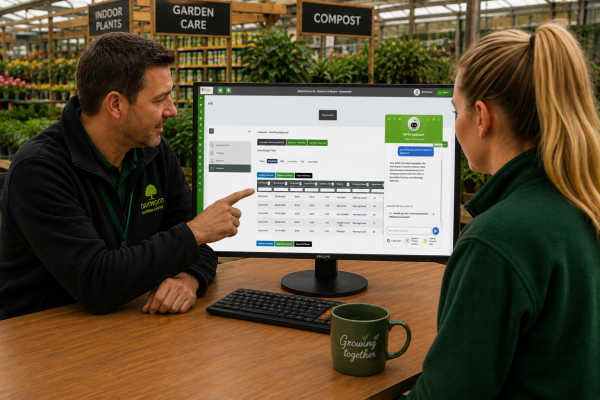
WorkForce Manager has been designed specifically for Garden Centres and Nurseries, bringing together every stage of the employee journey within a single platform.
Recruitment
Capture applicant information in one location and move successful candidates directly into onboarding without duplicate administration.
Onboarding
Create structured induction programmes, new starter checklists, mandatory training schedules, and policy acknowledgements to ensure consistency across the organisation.
Task Management
Assign tasks, monitor progress, capture completion records, and record management feedback to create a comprehensive performance history throughout probation.
Training & Compliance
Maintain records of training, certifications, assessments, and compliance activities against each employee profile.
Employee Records
Keep all onboarding, training, attendance, performance, and compliance information within one secure workforce platform, providing a complete audit trail when needed.
How AI Can Support Managers
As legislation becomes more demanding, managers need help staying on top of important activities.
WorkForce Manager’s integrated AI companion can help by:
~Highlighting overdue probation reviews
~Identifying incomplete training
~Flagging outstanding tasks
~Surfacing performance trends
~Helping managers find relevant workforce information quickly
Rather than replacing management judgement, AI helps ensure important actions are not missed and decisions are supported by accurate information and documented records.
Preparing for 2027 Starts Today
Although the legislation does not take effect until January 2027, the best time to review your probation process is now.
Businesses that establish structured onboarding, consistent performance monitoring, documented training, and reliable record-keeping today will be significantly better positioned when the new rules come into force.
Technology cannot replace good management. However, it can provide the structure, visibility, and evidence needed to support fair decisions, develop employees effectively and protect the business as employment legislation continues to evolve.
Are Your Probation Processes Ready for 2027?
Discover how WorkForce Manager helps Garden Centres and Nurseries manage recruitment, onboarding, task management, training and employee performance in one AI-powered platform.
Book a demo today and see how better records can support better workforce management.