
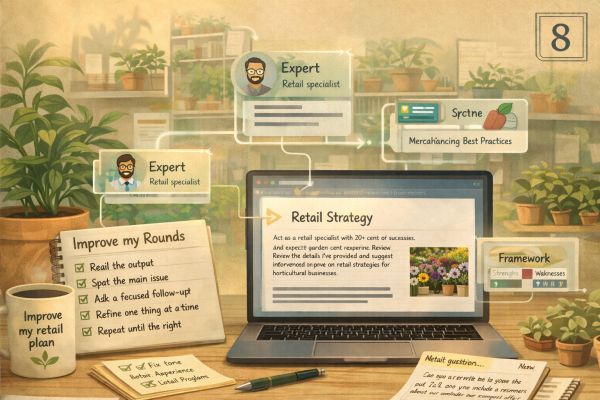
Start Getting Expert-Level Insight
Who this is for
This article is for garden centre owners and general managers who have moved past first experiments with AI and now want better judgement from it, not just faster wording. If week 7 helped you stop giving up on the first draft, this week is about making the next draft sharper, more informed, and less middle of the road.
Key Takeaways
AI often defaults to safe, average answers unless you point it towards better thinking.
You can improve output quality by naming experts, frameworks, case studies, or schools of thought.
If you do not know which experts matter, ask the model to suggest them first and explain why they are relevant.
Good expert-guided prompting uses outside thinking to shape the answer, not to copy someone else’s ideas blindly.
A small change to one prompt can turn a bland answer into something far more useful for real garden centre decisions.
How to get sharper thinking from AI
By now, you already know two important things from the earlier weeks. First, a weak answer is often just a weak first draft. Second, better context usually produces better output.
However, there is another reason AI often sounds flat. It tends to settle in the middle. Give it a broad question and it will usually reach for broad, familiar, safe wording. That is why so many answers feel sensible but forgettable.
At this stage, the problem is not always that the model needs more words from you. Sometimes it needs better direction. In other words, you are no longer only briefing the task. You are also shaping the quality of the thinking behind the answer.
A simple way to do that is to anchor the model to named experts, frameworks, or proven approaches. You are giving it a stronger lens to think through.
For example, asking, “How can we improve team communication?” will usually produce generic management advice. Asking, “How can we improve team communication using Amy Edmondson’s work on psychological safety and a practical garden centre management lens?” gives the model a clearer direction and a higher standard.
That does not mean the answer becomes automatically true. It means the model is more likely to follow a stronger framework, a clearer thought process, or a more distinctive language style. As a result, the answer is more likely to feel thoughtful, specific, and genuinely useful.
Why expert-guided prompts produce better AI output
Expert-guided prompts work better because they reduce the model’s temptation to drift into generic consensus. Without that steer, many models fall back on safe, familiar answers that sound reasonable but add very little.
They tell it what kind of reasoning you want, what standards matter, and what point of view should shape the draft.
That can help in three ways.
They improve depth. The model has a clearer body of thinking to draw from.
They improve direction. The answer follows a recognisable approach instead of wandering.
They improve usefulness. You get something you can react to, not just nod at.
This matters in a garden centre because many everyday decisions are not purely factual. They involve judgement. You may be deciding how to brief a seasonal campaign, how to run a more useful team meeting, how to improve a customer email, or how to organise ideas for a new service. In those cases, the quality of the framing changes the quality of the answer.
How to anchor AI to named experts, frameworks, or case studies
You do not need a huge reading list to do this well. Usually, one of these is enough:
a named expert
a management or marketing framework
a specific case study
a body of research
a known style of thinking
Here is what that looks like in practice.
Leadership and management prompts
If you want help improving a team briefing, you might ask AI to think through the issue using Amy Edmondson’s work on psychological safety or Peter Drucker’s focus on clarity and management by objectives. That usually produces something more grounded than a vague request for “better leadership advice”.
For example:
“Help me improve our morning team briefing for a busy garden centre. Use Amy Edmondson’s thinking on psychological safety and Peter Drucker’s emphasis on clarity of purpose. Structure it around what each team needs to know before the day starts: today’s priorities, key customer issues, stock or delivery points, safety reminders, and who owns what. Keep the language practical and relevant for a team working across the plant area, tills, café, shopfloor, and goods in.”
Innovation and problem-solving prompts
If you want fresh ideas rather than obvious ones, you can point the model towards approaches that value challenge and constructive feedback. Pixar’s Braintrust is a good example because it is often used to illustrate candid peer review. Satya Nadella is useful when you want a growth mindset, learning culture, and practical change leadership angle.
For example:
“Give me three ways to improve how our managers review new ideas for events and customer experience. Use the spirit of Pixar’s Braintrust for honest feedback and Satya Nadella’s growth mindset approach for learning and adaptation. Keep it realistic for one garden centre site, not a global company.”
Marketing prompts
Marketing is where this habit becomes especially useful. If you simply ask for a campaign idea, AI often gives you recycled seasonal copy. But if you ask it to use a clearer school of thought, the answer improves.
You might use Rory Sutherland for behavioural ideas, Byron Sharp for brand distinctiveness and memory, or a simple direct response lens if the goal is action.
For example:
“Write three ideas for promoting our autumn planter workshop. Use Byron Sharp’s thinking on distinctiveness so the message is memorable, and Rory Sutherland’s behavioural angle so the offer feels appealing without sounding pushy. Audience is local gardeners and gift buyers. Keep it suitable for Facebook.”
Where it helps in a garden centre
This approach works best when the task needs judgement, angle, or decision support rather than basic factual rewriting.
Seasonal marketing: Ask for campaign ideas shaped by a named marketing approach instead of generic social copy about compost, shrubs, or bedding plants.
Team leadership: Ask for a better huddle structure using recognised management thinking rather than broad advice about staff morale.
Customer communication: Ask for replies shaped by service principles, such as clarity first or reassurance first, depending on the situation.
Planning new offers: Ask AI to compare ideas using a known framework so it gives you trade-offs, not just a list.
For instance, if you are considering a click and collect improvement, a broad prompt might produce ten predictable ideas. A sharper prompt could ask the model to review the problem through service design principles, customer friction reduction, and practical retail constraints. That usually gives you something worth discussing with the team.
What to do when you do not know the right experts
You do not need to arrive knowing the right names. In fact, one of the most useful habits is asking the model to identify them first.
Try a two-step approach.
Ask AI which experts, frameworks, or case studies are most relevant to the problem.
Then ask it to redo the task using the best two or three, with a short explanation of why they fit.
For example:
“I want to improve how we launch new product ranges in store and online. Which experts, retail frameworks, or marketing thinkers would be most useful for this kind of task? Give me five options, explain each in plain English, and recommend the best two for a UK garden centre.”
Then follow with a stronger second prompt, using the habits from earlier weeks. In practice, that means adding proper context, making the goal clear, and telling the model what a good result needs to achieve. Peter Drucker’s emphasis on clarity of purpose is useful here. The model should know exactly what the launch plan is for, who it needs to reach, and what success should look like.
“Now use the best two approaches you recommended to draft a launch plan for our new outdoor pottery range. Use the shared the key context, including our target customer, price position, tone of voice, seasonal timing, available channels, and the decisions already made. Build the plan around a clear purpose: increase interest, drive store visits, and support sales without sounding generic or over-promotional. Keep it realistic for a single site garden centre and structure it around what each channel needs to do, including website, email, and in-store POS.”
That small extra step often makes a big difference because it gives the model stronger thinking and a clearer job to do.
Borrowed authority versus real synthesis
This is the part to handle carefully. Referencing experts does not magically make an answer wise. Sometimes AI will borrow the language of authority without doing much real thinking.
That is why you should watch for the difference between a name-drop and a proper synthesis.
Borrowed authority sounds like this: a few fashionable names, a polished tone, and not much substance underneath.
Real synthesis looks more like this: the answer explains the relevant ideas clearly, applies them to your actual situation, and shows where the trade-offs are.
A good test is to ask one follow-up question:
“Which parts of this answer come from the expert’s original thinking, and which parts are your own synthesis for this garden centre scenario?”
That helps you separate recycled authority from useful interpretation.
Common pitfalls
Using famous names for show: A big name does not help unless the thinker actually fits the task.
Choosing too many references at once: Three useful lenses are usually enough. Ten will often muddle the answer.
Skipping the adaptation step: Advice for global brands still needs translating for a local garden centre.
Confusing confidence with quality: A polished expert-style answer can still be weak or wrong.
Using sensitive internal information: Keep examples anonymised if you are discussing staff issues, financial figures, or customer data.
Forgetting last week’s lesson: Even strong expert framing may still need a second or third round to get truly useful.
Try this in 10 minutes
Pick one prompt you already use for planning, management, or marketing.
Run it as normal and save the answer.
Now ask the model which two or three experts, frameworks, or case studies are most relevant to that task.
Pick the best one or two.
Rewrite the prompt so it explicitly uses those references.
Compare the two outputs and highlight what became sharper, clearer, or more practical.
Keep the better version as a reusable prompt pattern.
A good starter task could be a product range launch, a team briefing format, or a customer service improvement idea.
Saveable tip sheet
When AI sounds generic, improve the thinking lens, not only the wording.
Use one to three relevant experts, frameworks, or case studies.
Ask AI to suggest the best experts first if you do not know them.
Choose references that fit the job, not the most famous names.
Always adapt the answer to your own site, customers, and team.
Watch for borrowed authority with no real substance.
Ask what is original thinking and what is synthesis.
Keep sensitive business details out of public tools.
Compare the expert-guided version with the plain version so you can see the improvement clearly.
Template prompt pack
Expert finder: “I need help with [task]. Which experts, frameworks, or case studies are most relevant to this problem? Explain each in plain English and recommend the best two for a UK garden centre.”
Leadership lens: “Help me improve [team issue]. Use ideas from [expert or framework] and adapt them for a garden centre team working across [departments]. Keep it practical and easy to apply this week.”
Marketing lens: “Create three ideas for [campaign or product launch]. Use [marketing expert or framework] to shape the thinking. Audience is [audience]. Tone is [your tone]. Avoid generic retail wording.”
Innovation lens: “Review this idea for [project]. Use [case study or innovation framework] to challenge it constructively. Show strengths, risks, blind spots, and one stronger version.”
Compare expert viewpoints: “Compare how [expert 1] and [expert 2] would approach this problem: [problem]. Show where they would agree, where their advice would differ, and what each approach would prioritise. Then recommend the strongest course of action for [your situation] and turn it into three practical next steps.”
Garden centre adaptation check: “Rewrite this advice so it fits a UK garden centre. Consider seasonal stock, customer footfall, staff time, and the need for clear practical wording.”
Borrowed authority check: “Show which parts of your answer come from named experts or frameworks and which parts are your own synthesis. Flag anything that needs checking.”
If you already use Workforce Manager
If you already use Workforce Manager, this habit can help you ask better questions about team communication and day-to-day management without turning the article into a software exercise. Useful prompts become stronger when they are grounded in anonymised, practical context you already understand.
A management prompt can be more useful when it reflects patterns you have noticed from Reporting, while keeping personal data out of the prompt.
A team briefing or shift communication prompt can be more practical when it reflects how work is organised in Shift / Rota Management.
A staff update prompt can be more practical when you are clear about who the message is for, what they need to know, and where they will read it, whether that is through the Employee Portal or the Mobile App.
What’s next
This week is about getting past average answers. Instead of accepting the first sensible draft, you are learning how to steer AI towards stronger thinking. Next week, we tighten the screws a bit more. Once you can produce a smart-looking answer, the next question is whether you should trust it. That is where verification comes in, and it is one of the most important habits in the whole series.