
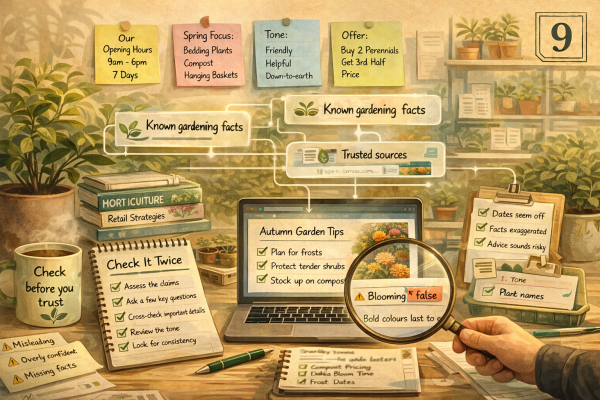
AI is useful. It is not automatically reliable.
Who this is for
This article is for garden centre owners and general managers who have started getting more useful answers from AI and now need a better way to test whether those answers can be trusted. Last week was about getting sharper thinking from the model. This week has a different purpose. It is about checking whether a strong-looking answer is actually reliable before you use it.
Key Takeaways
AI can sound calm, fluent, and convincing even when part of the answer is weak, outdated, or wrong.
The safest habit is to treat AI output as a first draft for review, especially when facts, figures, policies, timings, or claims matter.
Five simple checks can catch most problems: assumptions, sources, counterevidence, auditing, and cross-checking.
Asking for citations can help, but it does not remove the need for human judgement.
This week, run one important AI answer through a short verification checklist before you use it.
What this really means in practice
The simplest way to think about this is: AI is good at producing answers that sound convincing. That is not the same as producing answers that are fully correct, well-supported, or safe to use without checking.
That matters because a polished answer can create false confidence. If the wording is smooth, the structure is tidy, and the conclusion sounds sensible, it is easy to assume the thinking underneath must also be sound. Sometimes it is. Sometimes it is not.
This is the real shift in week 9. Earlier in the series, the focus was on getting better output. You learned how to write clearer prompts, add better context, improve weak answers in rounds, and steer the model towards stronger ideas. This week has a different job. It is about deciding whether a good-looking answer deserves your trust.
That is the difference between casual AI use and responsible AI use. Casual use says, “That sounds good, I’ll use it.” Responsible use says, “Before I use this, I need to know what it is based on, what it assumed, and what still needs checking.”
You do not need to treat every answer as dangerous. You do need to match your checking to the risk. A quick headline for a herb display is one thing. A customer reply, a product claim, an event notice, a staff update, or anything involving facts, figures, timings, or policy needs more care.
The most useful mindset is simple. Treat AI output as draft thinking that must earn trust before it is used. That one habit will make you a far more reliable AI user.
Why AI can sound right when it is wrong
AI is good at producing likely wording. It is not naturally careful in the way a good manager is careful. It does not pause because something feels slightly off. It does not automatically know which claim deserves double-checking. It does not worry about what happens if the wrong line ends up on your website or in front of a customer.
That is why a weak answer can still arrive in a polished format. In practice, there are a few common ways this shows up:
it states an assumption as though it were a fact
it gives a broad answer when your real situation is more specific
it blends together details from different sources
it invents a neat sounding explanation where the evidence is thin
it repeats a claim that sounds familiar without proving it
After week 8, you may be getting more thoughtful answers by steering AI towards better frameworks and stronger ideas. That is useful. Even so, sharper thinking still needs checking. In fact, a more expert-sounding answer can be more dangerous if the evidence underneath it is thin and the polish makes you lower your guard.
Why unverified AI output creates business risk
In a garden centre, the risk is usually not dramatic. It is practical. A wrong answer can waste time, confuse staff, disappoint customers, or create avoidable mess.
For example, imagine AI helps you draft a website paragraph about a new outdoor pot range. The writing sounds fine. However, it quietly suggests the range is frost-resistant across the board when only some lines are. That could create returns, complaints, and awkward conversations in store.
Or imagine it drafts an event notice and states the wrong booking process or date. Or it summarises a supplier sheet and leaves out an important limitation. Or it rewrites a customer reply in a way that sounds smooth but overpromises on delivery timing.
These are not strange edge cases. They are normal examples of what happens when fluent wording gets accepted too quickly.
The useful habit is not to fear AI. It is to apply sensible friction before the output goes live. Clear purpose helps here. You are not reviewing the answer to slow yourself down. You are reviewing it to make sure the answer is good enough for the job you want it to do.
The five verification lenses that catch most problems
You do not need a huge process. Most garden centre teams can improve validation simply by checking one answer through five short lenses.
The purpose of these checks is clarity. You are trying to separate what is known, what is inferred, what is missing, and what still needs confirming. Once that is clear, better decisions follow.
How to make AI show its working
When an answer matters, do not just ask the model to rewrite it more neatly. Ask it to unpack how it got there.
A useful review prompt is: “Separate this answer into four parts: source-backed claims, assumptions, inferences, and calculations. Label anything that still needs checking before use.”
That one step often reveals the real shape of the answer. You can see which parts are grounded, which parts are guessed, and which parts only sound stronger because they were written smoothly.
Assumptions
Start by asking what the answer had to assume in order to sound complete.
Many AI errors begin here. The model fills in missing context because the prompt did not provide it. In simple terms, AI is usually trying to give you a helpful, fast, complete-sounding answer. By default, it does not want to stop and say, “I am missing something important here,” unless you push it to. So it often fills the gap and moves on. Sometimes the assumption is harmless. Sometimes it changes the whole meaning.
Ask questions like:
What assumptions did you make to produce this answer?
Which assumptions are certain, and which need checking?
What part of this answer depends on missing information from me?
This is especially useful when the output sounds oddly specific even though you did not give much detail. In the early days of ChatGPT, you could give it a person’s name, add one completely made-up fact, and it would often charge off like an overconfident pub storyteller. Suddenly that person had a dramatic backstory, a suspiciously detailed career, two life-changing turning points, and probably a Labrador called Max. It all sounded wonderfully certain, which is exactly why checking assumptions matters.
Sources
Then ask where the answer came from. If the model is using web access or uploaded files, source checking becomes much more useful. If it is answering from general model knowledge, source requests can still help, but they need more caution.
Ask:
Which sources support your main claims?
Separate what came from my files, what came from the web, and what is your own general explanation.
Show me the exact line or section that supports this claim.
This helps you see whether the answer is grounded in something real or simply sounds informed.
Counterevidence
A surprisingly strong way to test an answer is to ask the model what might challenge it.
Ask:
What is the strongest reason this answer might be incomplete or wrong?
Show me one credible alternative view or conflicting source.
What would a cautious manager want to double-check before using this?
This forces the model to pressure-test its own answer rather than only defend it.
Auditing
This matters most when there are numbers, calculations, lists, dates, or comparisons involved.
Ask:
Recheck the figures and show each step clearly.
List the exact inputs you used for this summary or comparison.
Which numbers came directly from my material, and which did you infer?
Even when the model does not make a dramatic mistake, auditing often reveals small slips, dropped details, or neat summaries that oversimplify the source material.
Cross-checking
Finally, compare the answer against something outside itself.
That might mean:
checking the answer against your own source document
checking it against the supplier page or product sheet
asking the model to compare two sources side by side
running the same question again with tighter instructions
asking another AI tool the same question, next week we go into this method in more detail
Cross-checking matters because AI can repeat its own weak assumption if you only ask it to polish the same answer again.
When citation requests help, and when they can still mislead
Many people discover one useful trick at this point: ask for citations. That can help, but it is not a magic fix.
Citations help when they let you trace a claim back to a real source you can inspect. For example, if AI summarises a supplier document and points you to the section on outdoor durability, that is useful. If it browses the web and gives you a current source for public opening information, that is also useful.
However, citation requests can still mislead in a few ways:
the source may be real, but the model may have overstated what it says
the source may be old, weak, or not the best authority
the source may support part of the answer, but not the most important claim
the answer may combine sourced facts with unsourced inferences so smoothly that the difference is easy to miss
So yes, ask for citations where they help. Then read enough of the source to confirm the meaning. A citation is a starting point for checking, not the end of checking.
A red-flag list for suspect AI output
Some answers deserve extra caution straight away. Watch for these signs:
the answer sounds more certain than your source material
it includes precise claims you never supplied
it skips caveats that matter in real life
it smooths over differences between products, dates, or policies
it uses phrases such as always, never, guaranteed, fully suitable, or best without evidence
the wording is polished, but the reasoning is hard to trace
it gives numbers, rankings, or comparisons without showing how they were built
it cites sources, but the claims still feel oddly broad or too neat
it sounds more expert or authoritative than the evidence underneath actually supports
When you notice two or three of those together, slow down and check properly.
What pressure-testing looks like in practice
Let’s use a simple example. Imagine you ask AI to draft a customer-facing answer about a new peat-free compost range. The model gives you this polished line:
“Our new peat-free compost range is ideal for all planting jobs and performs just as well as traditional compost across the board.”
At first glance, that sounds strong. It is tidy, clear, and positive. However, it should set off alarms.
Start with assumptions. Did you actually provide evidence that the whole range is ideal for all planting jobs? Probably not.
Then check sources. Is that statement taken from your supplier material, your own trial notes, or nowhere clear?
Next, ask for counterevidence. Are there situations where certain customers may need a more specific product or slightly different watering expectations?
Then audit the wording. “Across the board” is a very broad claim. “Ideal” is also doing a lot of work.
Finally, cross-check it against the actual product information. You may find the safer answer is closer to this:
“Our peat-free compost range is suitable for many everyday planting jobs, although some products in the range are designed for more specific uses. If you are choosing for seed sowing, containers, or a particular plant type, we can help you pick the right one.”
That second version may feel less dramatic. It is far more trustworthy. It is also more useful to the customer because it reflects the real limits of the claim.
Where it helps in a garden centre
Customer replies: Check whether the answer solves the real question or quietly overpromises on stock, delivery, or suitability.
Website copy: Review claims about product performance, care advice, availability, and timings before they go live.
Event promotion: Verify dates, booking steps, audience details, and what is included before publishing.
Internal summaries: Make sure the model has not merged assumptions into facts when summarising notes, supplier updates, or planning documents.
This is where AI becomes more valuable, not less. Once your team gets into the habit of checking output properly, you can use AI more often with better judgement.
Common pitfalls
Trusting polish too quickly: smooth wording is not evidence.
Checking only the final sentence: the real problem often sits in the assumptions underneath.
Asking for citations and stopping there: you still need to inspect whether they truly support the claim.
Using AI as the source instead of a helper: the source should usually be your files, your website, supplier documents, or other trusted material.
Skipping number checks: dates, prices, figures, stock details, and comparisons deserve extra care.
Pasting in sensitive data: keep staff, customer, payroll, and confidential commercial information out of public AI tools. Use anonymised examples where needed.
Try this in 10 minutes
Pick one AI answer you created recently that includes facts, claims, timings, or advice.
Paste it into a new chat and ask: “Treat this as draft thinking, not final truth. List the assumptions behind it.”
Then ask: “Show which parts are grounded in source material and which parts need checking.”
Ask one counterevidence question: “What is the strongest reason this answer might be incomplete or misleading?”
If there are any numbers, dates, lists, or comparisons, ask the model to recheck them step by step.
Compare the revised answer against your real source material.
Keep a note of what changed. That note will teach you where your prompts or source pack still need strengthening.
A good starter task could be a product claim, a delivery reply, an event notice, or a short website FAQ.
Saveable tip sheet
Treat AI output as a draft for review.
Check assumptions before wording.
Ask where each major claim came from.
Look for one credible challenge to the answer.
Audit numbers, dates, and comparisons carefully.
Cross-check against your real source material.
Use citations as a guide, not proof on their own.
Be cautious with broad claims and tidy sounding certainty.
Keep sensitive business and personal data out of public tools.
For anything important, slow down before you publish or send.
Template prompt pack
Assumption check: “Review this answer and list every assumption it makes. Mark each one as safe, uncertain, or needs checking.”
Source split: “For each major claim in this draft, show whether it comes from [your uploaded files], web browsing, or your own general explanation. Flag anything unsupported.”
Counterevidence check: “What is the strongest credible challenge to this answer? Show me what a cautious manager should verify before using it.”
Audit the details: “Recheck every number, date, comparison, and list in this answer. Show your working clearly and highlight anything that may have been inferred.”
Claim pressure test: “Rewrite this answer more cautiously. Remove any claim that is stronger than the evidence provided. Keep it clear and customer friendly.”
Red-flag scan: “Scan this draft for signs of overconfidence, vague sourcing, broad claims, or missing caveats. Explain each red flag briefly.”
Source-first rewrite: “Using only [your policy / your supplier sheet / your website copy], rewrite this answer. If the source does not support a claim, do not include it.”
Manager review mode: “Pretend you are reviewing this for a busy garden centre manager. What could cause confusion, complaints, or unnecessary risk if this went live as written?”
What’s next
This week is about learning not to hand authority to the first fluent answer. That is a major step forward. Once you can get sharper outputs and then test them properly, you are using AI with much better judgement. Next week, we build on that by looking at how to compare models and cross-check claims more deliberately, so important work is less dependent on one tool giving one answer.